The Mechanics of Aspects (Drishti): How Planets "See" Each Other
By Vishal Bhardwaj
•May 21, 2026
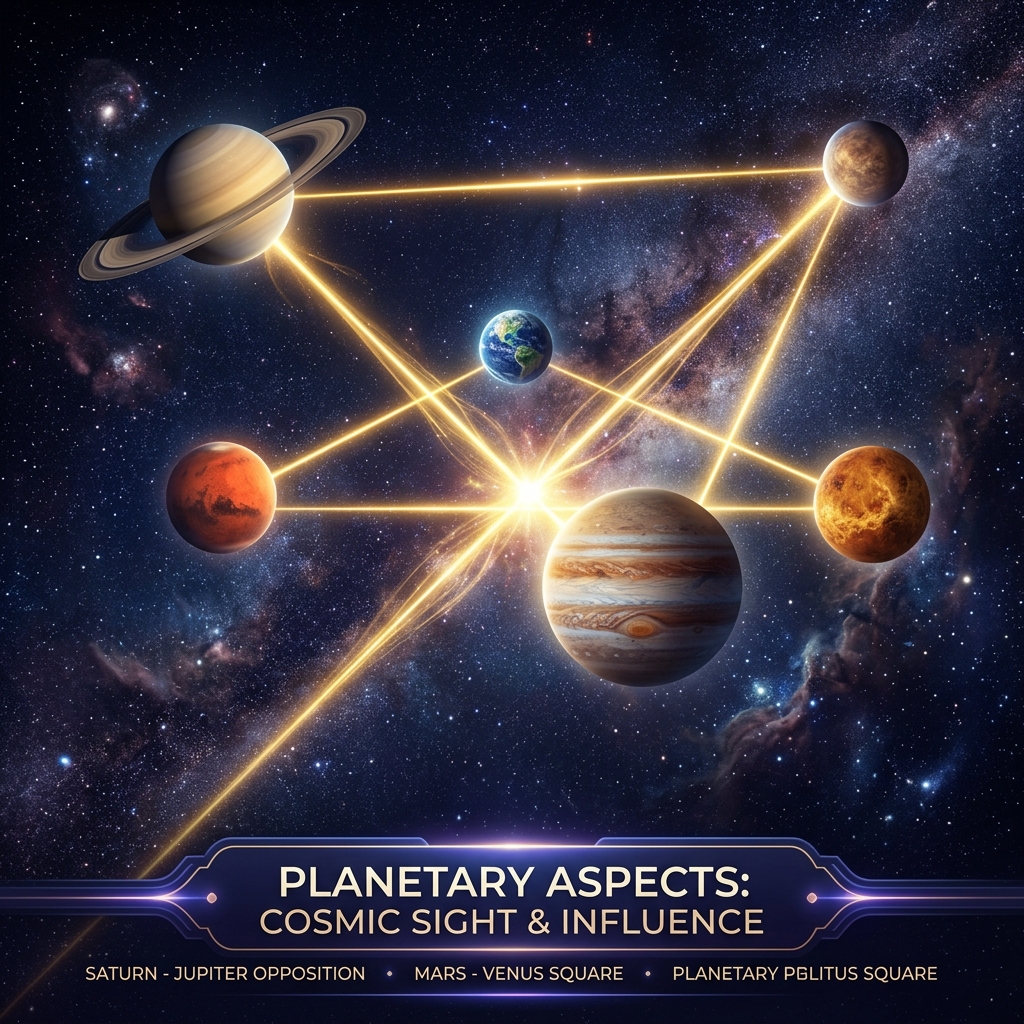
A birth chart is not static. The planets don't just sit in their houses isolated from one another. They actively project their energy across the chart, influencing houses and other planets far away. In Vedic Astrology, this line of sight is called Drishti (Aspect). The word Drishti literally translates to "vision" or "glance."
The Universal Aspect: The 7th House Glance
The fundamental rule of Drishti is simple: Every planet looks directly across the room.
All seven visible planets (Sun, Moon, Mercury, Venus, Mars, Jupiter, Saturn) aspect the 7th house from where they sit. For example, if Venus is sitting in your 1st House, it is looking directly at your 7th House (the house of marriage). Therefore, Venus will bring its loving, aesthetic energy into your relationships, even if Venus itself isn't physically located in the 7th House!
The Special Aspects of the Outer Planets
While every planet has the standard 7th house aspect, the three slower, "outer" planets—Mars, Jupiter, and Saturn—have been granted special aspects. These special glances allow them to exert massive influence over the chart.
Mars (Mangal): The Protector's Glance
Aspects: 4th, 7th, 8th
Mars represents protection, logic, and sudden action. Its 4th aspect represents where Mars puts up a defensive shield. Its 8th aspect represents where Mars can cause sudden transformation or accidents. (Count inclusive of the house Mars sits in).
Jupiter (Guru): The Guru's Blessing
Aspects: 5th, 7th, 9th
Jupiter is the great benefic. Wherever Jupiter looks, it expands and protects. Its 5th and 9th aspects (the trines) represent pure grace, intelligence, and divine luck. Having Jupiter aspect a difficult house is like having a wealthy benefactor step in to pay your debts.
Saturn (Shani): The Judge's Stare
Aspects: 3rd, 7th, 10th
Saturn's glance is heavy and cold. It slows things down, demands hard work, and restricts. Its 3rd aspect requires immense effort, and its 10th aspect forces you to take on heavy career responsibilities. Where Saturn looks, you must earn everything through sweat and tears.
The Nodes: Rahu and Ketu
In many traditional schools (like Parashara), Rahu and Ketu are said to cast aspects on the 5th, 7th, and 9th houses from their position, similar to Jupiter (but casting chaotic, illusionary energy instead of grace). However, because they are shadow planets without physical bodies, some astrologers argue they only influence the planets they conjoin. For beginners, it's safest to assume they highly impact the houses exactly opposite them (the 7th).
Mutual Aspects (Sambandha)
When two planets look at each other, a profound energetic connection is formed called Sambandha. If the Sun is in the 1st House and Saturn is in the 7th, they are looking directly at each other. Because the Sun represents authority/ego and Saturn represents servitude/delay, this mutual aspect creates a lifelong internal tug-of-war between confidence and self-doubt.
But how do we know if two planets looking at each other will be a friendly collaboration or a violent war? That brings us to our next topic: Planetary Friendships (Maitri).